




Facilities Dive News: Boosting HVAC efficiency with new technologies
Nanofluids offer quick, low-cost ways to improve performance without system upgrades or replacements, manufacturers say, with even newer innovations on the horizon.
March 14, 2024 (Facilities Dive News, Joe Burns reporting) –
Space heating, cooling and ventilation represent more than half of the total fuel consumption in the U.S. commercial sector. Among these, space heating is the largest segment, at 32%, followed by ventilation at 11% and cooling at 9%, according to the U.S. Energy Information Administration.
In part due to HVAC systems’ large energy demands, these systems require careful consideration in maintenance, operating and capital expenditure budgets. They often require more maintenance attention — and use more energy — as they age due to issues like dirty coils, corrosion in refrigerant loops and heat exchanger oil fouling. The latter problem can lead to efficiency losses, maintenance costs resulting from the removal of fouling deposits or the replacement of corroded or plugged equipment. More concerning, perhaps, is that oil fouling can require planned or unplanned system shutdowns, according to research by Hassan Al-Haj Ibrahim of the Arab University for Science and Technology. To improve the life cycle of heating and cooling systems, reduce oil fouling problems and improve efficiency, some building operators are looking to new chemical and material science technology additives like nanofluids.
Certain additives have the potential to significantly improve HVAC output. Research in Energy Reports found that using aluminum oxide nanofluid can enhance heat transfer and improve air conditioner system performance by approximately 22%. Because such additives are implemented through noninvasive treatments, they could offer building operators a cost-effective alternative to replacing existing HVAC systems or implementing building automation systems to improve performance.
Where U.S. buildings are using HVAC nanofluids
HT Materials Science offers an aluminum oxide nanofluid product named Maxwell for commercial and industrial thermal systems. The nanoparticles “are only 2% by volume of a typical system, so it’s not a dump and replace. It’s a pure additive, and, generally speaking, no [capital expenditure] is required,” HT Materials Science CEO Tom Grizzetti said in an interview.
The company projects a 10% to 15% increase in energy efficiency across the additive’s more than 10 year life cycle, with those improvements degrading less than 1% in that time, Grizzetti said. HTMS focuses on a two- to four-year payback period, depending on utilization, for its customers, he added.
“We’d like to focus on commercial and industrial because you need [high] utilization,” Grizzetti said. “If you don’t use it, you don’t save.” Large-scale office buildings with district cooling or other “larger infrastructure projects” like an airport are among the use cases he suggests.
HTMS’ Maxwell product was evaluated in a summer 2023 pilot at a district cooling plant in a suburb of Abu Dhabi, United Arab Emirates. The trial, which studied the nanofluid’s effects on chilled water energy use at a 55,742-square-meter educational campus, found that the additive increased the efficiency of the plant’s chillers by 13.6% and increased overall plant efficiency 9% compared with 2022, according to HTMS.
Back in the U.S., HVAC system nanofluids are also being piloted, tested and even celebrated. Phoenix, which expects to exceed last year’s record summer heat this summer, is implementing nanofluid technology to improve cooling systems in city-owned buildings.
Phoenix partnered with ECM Technologies on a $2.5 million contract to implement the company’s ThermaClear nanofluid in HVAC systems of public facilities, with the first phase treating 469 HVAC units across Phoenix fire department and police department buildings. This phase, which concluded in January 2023, treated 3,805 total tons of equipment and is estimated to have provided over 1,350 megawatt hours in annual energy savings to the departments, alongside more than $100,000 saved in annual HVAC service and repair costs, according to the Phoenix Business Journal.
Since then, the partnership has expanded to use the additives in HVAC systems at 16 public library locations, and Sky Harbor International Airport’s treatment is underway. Separately, the Phoenix Art Museum has saved more than $18,000 in annual HVAC energy costs and approximately 123 metric tons of carbon dioxide equivalent since treating its three 350-ton Trane water-cooled chillers with ThermaClear.
“We’re the Lipitor to the HVAC system,” David Fenton, managing director of ECM Technologies, told Facilities Dive, comparing the company’s ThermaClear product to a drug used to reduce “bad” cholesterol and other fats in the bloodstream. “We inject it into the refrigerant loop. It gravitates to the metal and displaces the oil and sludge that’s there, and then it forms a covalent bond to the metal, preventing that oil from sticking.”
In terms of savings, Fenton says the average return on investment for ThermaClear’s one-time treatment is between 12 and 36 months, with operational savings of 15% to 20% per year on average. In addition to cost savings, many companies are implementing ECM Technologies’ nanofluids to drive decarbonization efforts, Fenton noted.
“If we’re reducing electricity [use], we’re definitely having an impact on carbon reduction,” Fenton said. Other goals differ by customer, he said. “Some companies, if we can extend the life of that equipment by another 2, 3 or 4 years and defer [capital expenditures], that’s pretty significant. And then others are looking just to cut their annual operating costs or their biggest fixed cost, which is electricity.”
Other ECM Technologies customers include facilities of Arizona State University, GoDaddy, TransWestern and Morgan Stanley, Fenton said. The firm is focused on serving warmer U.S. regions like the Southwest and Sun Belt. “The most juice for the squeeze in terms of payback, and the fastest performance improvement units, are going to happen in areas where they’re running air conditioning the most,” Fenton said.
Other innovations on the horizon
Material science firms and HVAC firms are starting to work together to improve system efficiency from the outset. For example, Montana Technologies’ AirJoule dehumidification, air conditioning and atmospheric water harvesting technology will incorporate GE Vernova’s proprietary sorbent materials in a new joint venture operating under the AirJoule name, the companies announced Monday.
Researchers at the University of Texas at Dallas are developing a quick-drying polymeric desiccant that could dehumidify buildings using at least 30% less energy than conventional air-conditioning systems.
Shuang Cui, principal investigator and assistant professor of mechanical engineering at the university’s Erik Jonsson School of Engineering and Computer Science, said in a Feb. 21 release that this desiccant material would be used to coat a rotating cylinder, sucking in water and then removing the absorbed moisture as the mechanism rotates and the material is exposed to low heat.
The thermo-responsive material can make air conditioning more efficient by separating the dehumidification and heat removal processes and improving the most energy-consuming processes, the news release said. Unlike traditional air-conditioning systems, those utilizing the new desiccant material would not need to cool coils at low temperatures to condense moisture from the air and would likely not need to be heated to high temperatures to evaporate collected moisture, the release said.
The research is part of an interdisciplinary effort that includes other researchers from Texas A&M University, the University of Utah and private HVAC firm OxiCool. The project, which began in 2023, will continue working to optimize the thermo-responsive polymers to find out which formulas work best at absorbing moisture and drying quickly at low energy input.
‑ Reproduced from original source
Tabreed Boosts its Roadmap to Net-Zero
Tabreed Boosts its Roadmap to Net-Zero, following Impressive Results from World-first District Cooling Nanofluid Pilot Study
Thursday, November 09, 2023
Pioneering nanofluid technology, developed by HTMS, demonstrates potential to increase District Cooling energy efficiency by up to 15%
Abu Dhabi, United Arab Emirates – 09 November 2023: Tabreed, the world’s leading district cooling company, in partnership with Ireland-based HT Materials Science (HTMS), has concluded what is believed to be the world’s first pilot project of its kind, demonstrating results that provide real hope for significant gains in energy efficiency.
Applied across Tabreed’s current portfolio of 89 district cooling plants, the heat transfer fluid technology developed by HTMS – known as ‘Maxwell’ – could result in efficiency increases of between nine- and 15%. Theoretically this could mean preventing approximately 200,000 metric tons of greenhouse gas (GHG) emissions annually, as a result of decreased electrical energy consumption. For context, this would equate to removing 43,500 cars from the roads each year as a result of saving 335 million kWh of electricity, which is enough to power approximately 20,000 homes.
Maxwell, named after James Clerk Maxwell, the pioneering scientist who first developed the concept of nano fluids in the 19th century, is an engineered suspension of sub-micron aluminium oxide particles in a base fluid of water or water/glycol (‘nanofluid’) – a drop-in additive for cooling and heating systems, that works by enhancing heat transfer. It was trialled in the summer of 2023 at a Tabreed district cooling plant in Khalifah City, Abu Dhabi, which exclusively supplies chilled water to a 55,742 square metre educational campus.
The performance of the Maxwell nanoparticle fluid technology at Tabreed’s facility, evaluated under industry-approved Energy Efficiency Analysis (EEA), demonstrated that its addition increased efficiency of the plant’s chillers by 13.6%, leading to an overall plant efficiency improvement of 9.0%, compared with the same period in 2022.
Tabreed’s CEO, Khalid Al Marzooqi, said this development is testament to the company’s tireless pursuit of energy efficiency at every level of its operations, adding that “as a sustainable cooling champion focused on innovation, we are always looking for ways to accelerate the energy transition and provide more efficient services that benefit our customers, our stakeholders and the communities in which Tabreed operates.
“This successful pilot project proves the power of international partnership and technological collaboration, and we look forward to working with HTMS to further the application of their technology to advance sustainable cooling solutions that benefit communities and industries across the world.
“In real terms, what we are looking at here is a potentially seismic improvement in energy efficiency that could radically change this industry. That Tabreed is spearheading such developments should not be a surprise, and I am proud to be leading such a progressive and impactful company that’s completely aligned with the UAE’s inspirational Net-Zero strategy.”
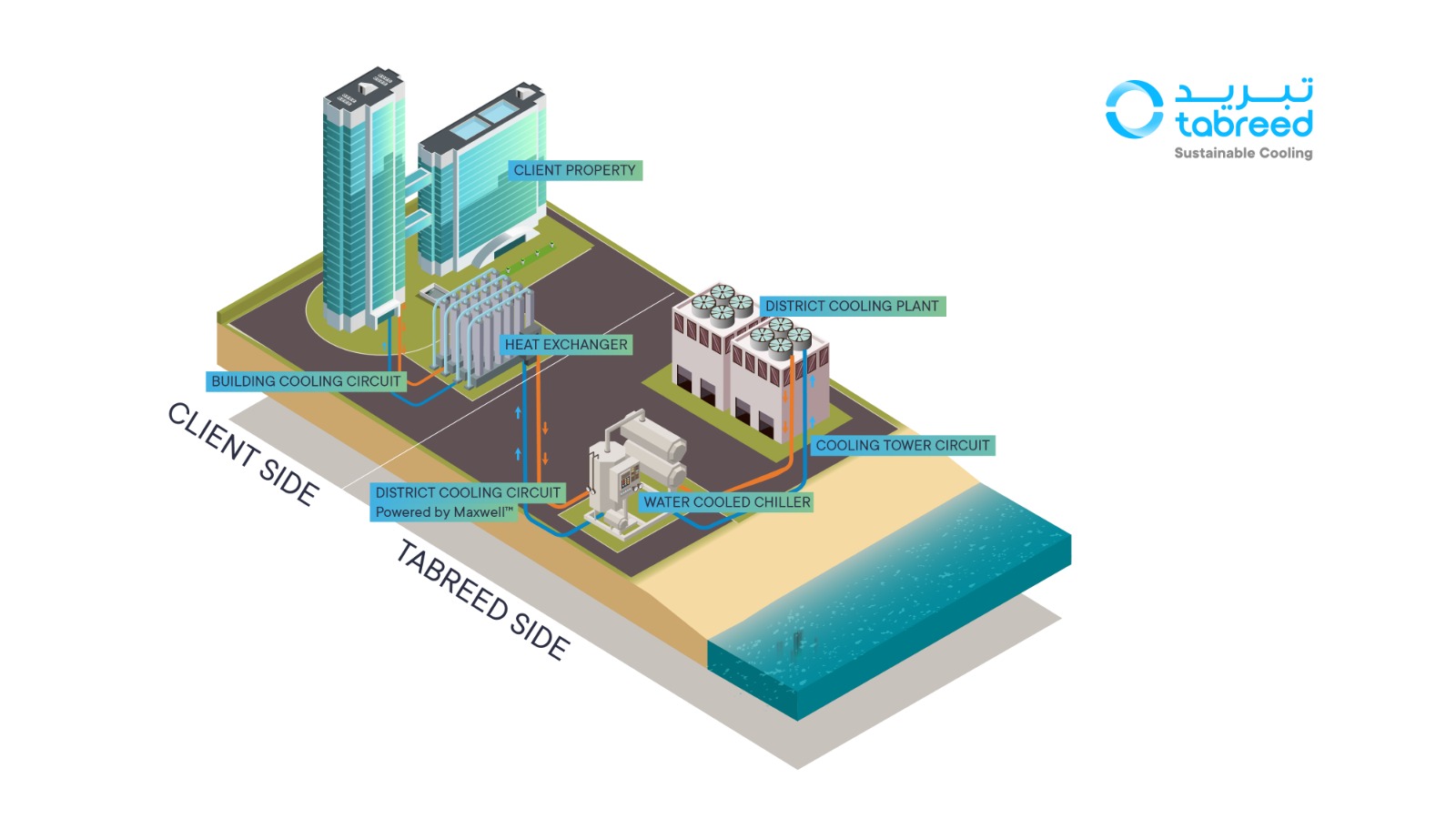
How Maxwell Works in a Chilled Water System
Maxwell’s nanotechnology increases the thermal capacity of water, the base fluid for commercial and industrial chilled water systems. When added to a chilled water loop at a 2% concentration of nano materials, Maxwell increases the system’s cooling capacity by up to 15%. This increased cooling capacity allows chillers, fan units, pumps and other equipment to operate more efficiently, reducing electrical energy consumption and carbon emissions. Maxwell is a non-toxic, non-corrosive material and fully recoverable and recyclable.
Next Steps
Following the promising pilot study results, Tabreed and HTMS are in discussions to introduce the Maxwell technology to other district cooling facilities in the company’s portfolio. With cooling accounting for an estimated 70% of energy consumption in the GCC, and global demand expected to triple by 2050, this technology could potentially play a critical role in reducing the environmental impact of an industry already widely viewed as an essential contributor to sustainability, with district cooling being up to 50% more energy efficient than conventional cooling methods.
Commenting on the successful pilot project, Thomas Grizzetti, CEO of HTMS, said: “Thanks to the ease of installation, and use in both new and existing HVAC systems, Maxwell can have a material impact on energy usage and the carbon footprint of a broad range of industries and sectors globally. Maxwell is a significant step forward for businesses wishing to drive down energy use, increase system capacity and meet regulated energy efficiency targets increasingly promulgated by governments globally. We believe Tabreed is an ideal strategic partner for HTMS to help achieve widespread adoption of this unique technology.
‑ Reproduced from original source